CogAT sample questions for 2nd grade, with answers explained
By Gradecairn Publications, publisher of the Gradecairn Gifted Test Prep workbooks. Each question format is described from Riverside Insights' own CogAT product guide, listed under Sources.
Last updated: October 2026
Verified: Every question and answer below was cut by script from the final printed Grade 2 workbook and its answer key, on 15 October 2026.
Here are CogAT sample questions for every question type at Level 8, the level for 2nd grade: one practice question of each kind, with its answer and the reason printed in our answer key. We wrote these questions for our workbook. They are not real CogAT items, but they follow the formats Riverside describes for Levels 5/6 to 8 [1]. Many schools use the CogAT to choose children for gifted and talented programs [4].
TL;DR
- The CogAT Level 8 has 9 question types in three parts: Verbal, Quantitative, and Nonverbal.
- At this level every question is pictures, shapes, or numbers, and an adult reads the directions aloud.
- Each question has three answer choices, A, B, and C.
- Read the reason together after each answer; the reason is where the learning happens.
How should we use these sample questions?
Sit with your child, read the question aloud, and let your child point to A, B, or C before you look at the answer. Then read the reason together. At Levels 5/6 to 8 the real test reads every direction aloud and has three answer choices per question, so practice the same way [2].
The real test also opens each subtest with a few sample questions, so your child will see the format again on the day [1]. Riverside's own parent guide shows one of its sample items for each subtest at the 2nd grade level [5].
What does a CogAT Picture Analogies question look like?
A Picture Analogies question shows a 2 x 2 grid with three pictures and one empty box. Your child works out how the two top pictures go together, then picks the picture that makes the bottom pair go together the same way [1]. It is the first Verbal subtest.
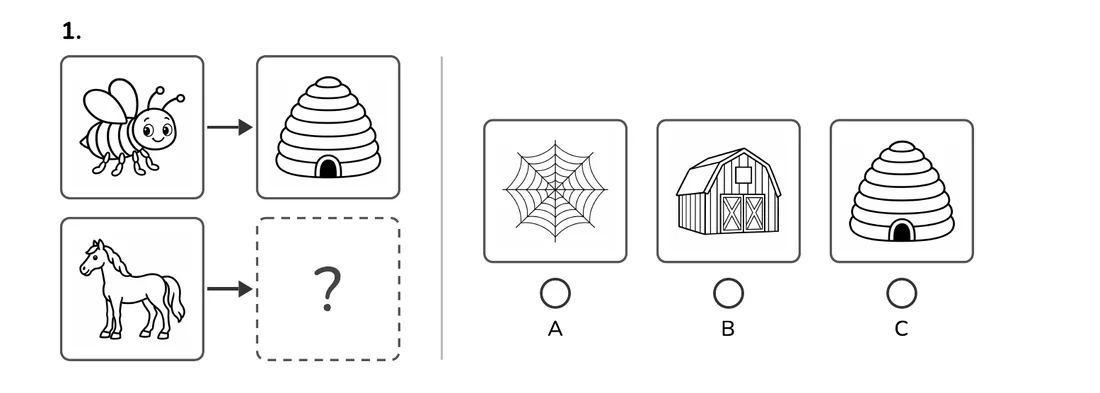
Top row: a bee, then a beehive. Bottom row: a horse, then an empty box. The choices are A, a spider web; B, a barn; and C, a beehive.
The answer is B. The key says: "A bee lives in a hive. A horse lives in a barn."
What does a CogAT Sentence Completion question look like?
In Sentence Completion the adult reads a question or sentence aloud, and your child picks the picture that answers it or completes it [1]. It is the only subtest at this level that uses spoken words, and Riverside lists it as optional [1].

Read aloud: "Which one can cut?" The choices are A, broccoli; B, a saw; and C, a rainbow.
The answer is B. The key says: "The question is: 'Which one can cut?' The answer is the saw."
What does a CogAT Picture Classification question look like?
Picture Classification shows three pictures in the top row. Your child thinks about how they are alike, then picks the answer picture that belongs in the same group [1]. The group can be things you wear, things in the sky, parts of the body, and many more.
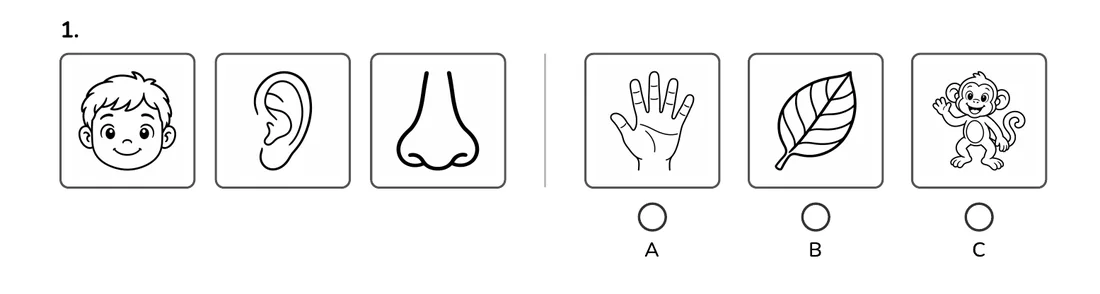
Top row: a face, an ear, and a nose. The choices are A, a hand; B, a leaf; and C, a monkey.
The answer is A. The key says: "The three pictures are all parts of the body. The hand is too."
What does a CogAT Number Analogies question look like?
Number Analogies uses the same 2 x 2 grid as Picture Analogies, but the link between the pictures is a number, shown with groups of things [1]. It is the first Quantitative subtest. Your child counts the change in the top row and makes the same change in the bottom row.
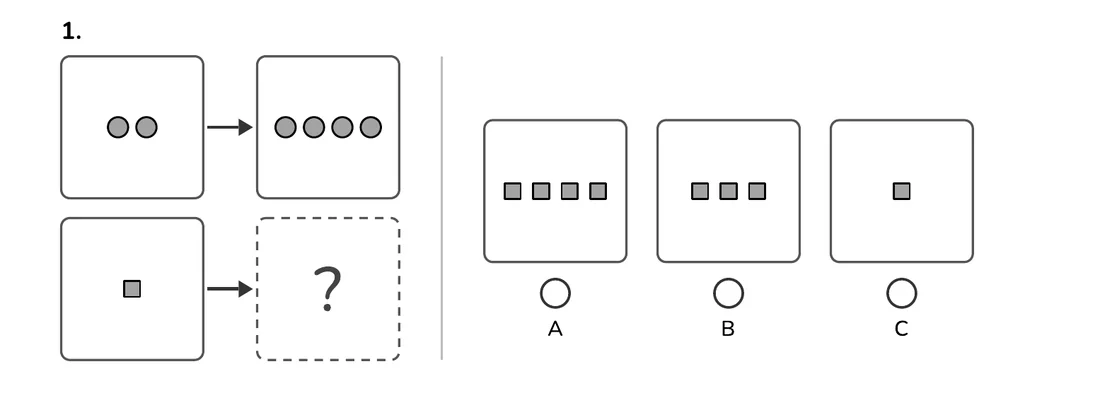
Top row: 2 dots become 4 dots. Bottom row: 1 square becomes what? The choices are A, 4 squares; B, 3 squares; and C, 1 square.
The answer is B. The key says: "Top row: 2 becomes 4, which is 2 more. Bottom row: 1 becomes 3."
What does a CogAT Number Puzzles question look like?
A Number Puzzles question shows two trains. Your child picks the car that makes the second train carry the same number of things as the first train [1]. At Level 8 some Number Puzzles questions are a number sentence with a missing number instead [1].
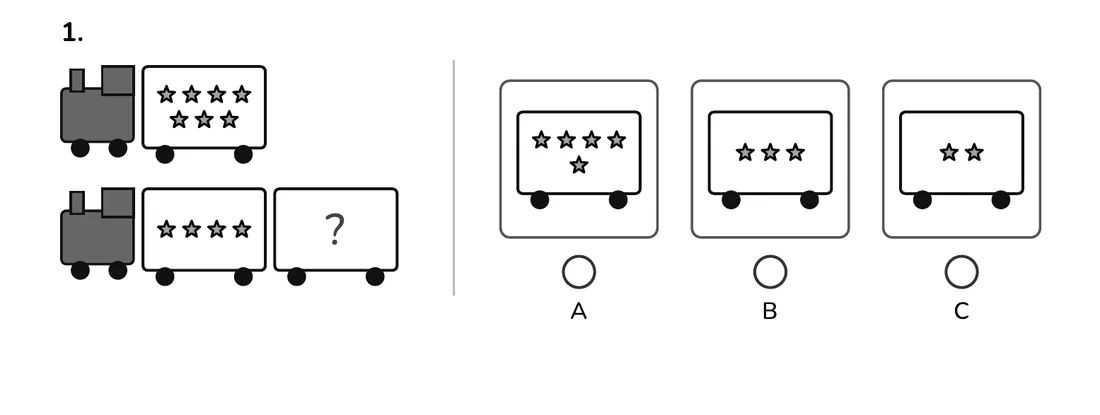
The first train carries 7 stars. The second train carries 4 stars and has one empty car. The choices are cars with A, 5 stars; B, 3 stars; and C, 2 stars.
The answer is B. The key says: "The first train carries 7. The second already carries 4, so the empty car needs 7 - 4 = 3."
What does a CogAT Number Series question look like?
Number Series shows strings of beads on an abacus that make a pattern. Your child finds the pattern and picks the string of beads that comes next [1]. Counting the beads on each rod out loud is the easiest way in.
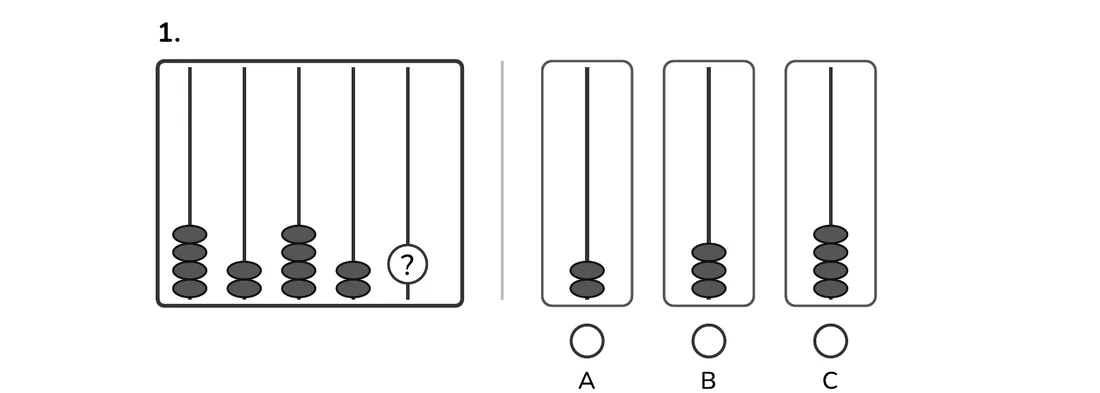
Five rods: 4 beads, 2 beads, 4 beads, 2 beads, and a question mark. The choices are rods with A, 2 beads; B, 3 beads; and C, 4 beads.
The answer is C. The key says: "Count the beads: 4, 2, 4, 2. The rods go 4, 2, 4, 2 over and over, so the next rod has 4."
What does a CogAT Figure Matrices question look like?
Figure Matrices uses the 2 x 2 grid again, this time with shapes [1]. It is the first Nonverbal subtest. Your child sees what changes from the first shape to the second, such as the number, size, or color, and makes the same change below.
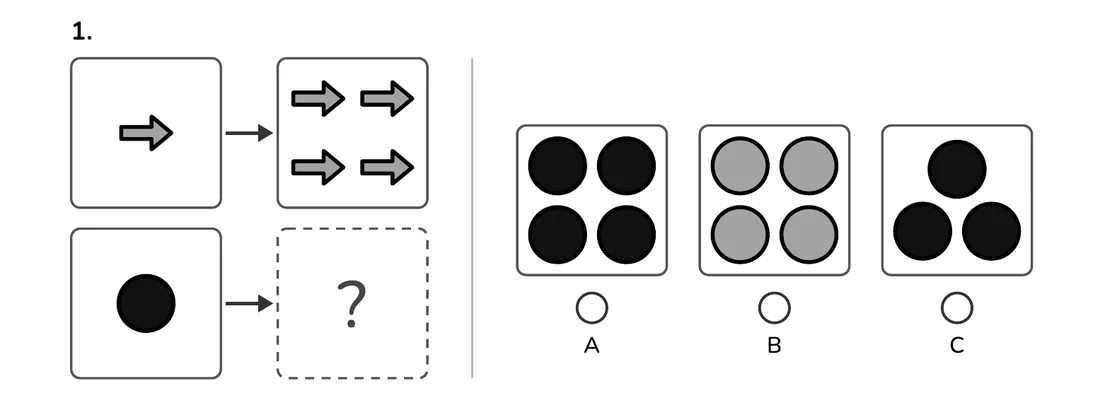
Top row: one grey arrow becomes four grey arrows. Bottom row: one black circle becomes what? The choices are A, four black circles; B, four grey circles; and C, three black circles.
The answer is A. The key says: "Look at the top row: 1 shape becomes 4 shapes. Do the same to the bottom picture."
What does a CogAT Paper Folding question look like?
In Paper Folding your child imagines a piece of paper that is folded, cut or punched with a hole, and then opened out, and picks how it looks when opened [1]. Our workbook practices both kinds in two sections, Holes and Cuts.
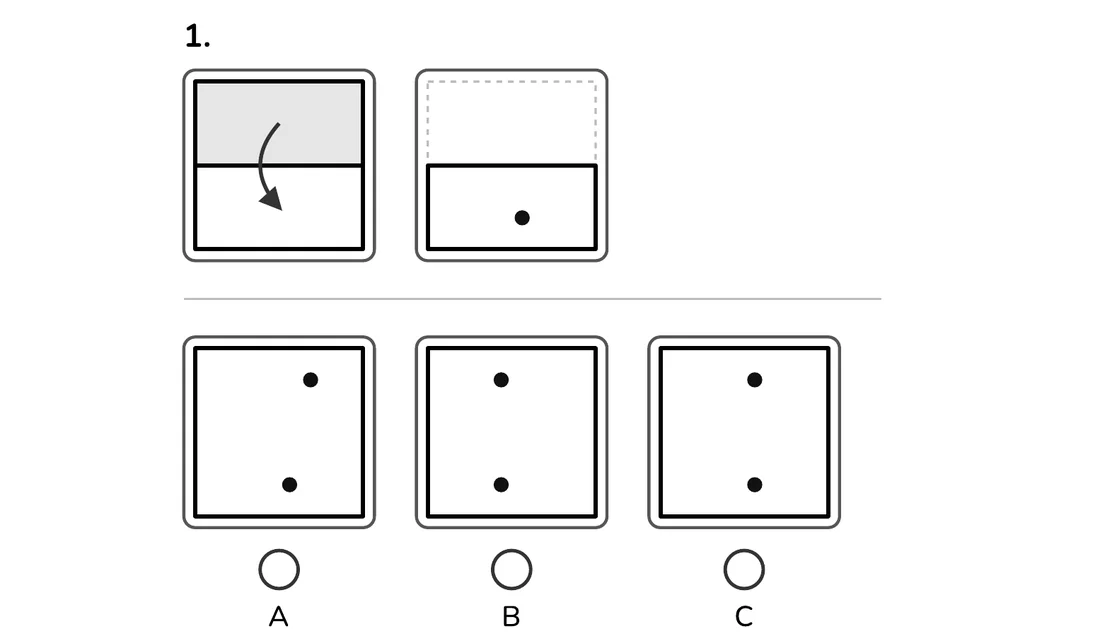
Holes: the top half of a square sheet is folded down, and one hole is punched through the folded paper. The choices show the opened sheet with two holes in three different places.
The answer is C. The key says: "The top half is folded down. The punch goes through 2 layers of paper, so there are 2 holes, mirrored across every fold line."
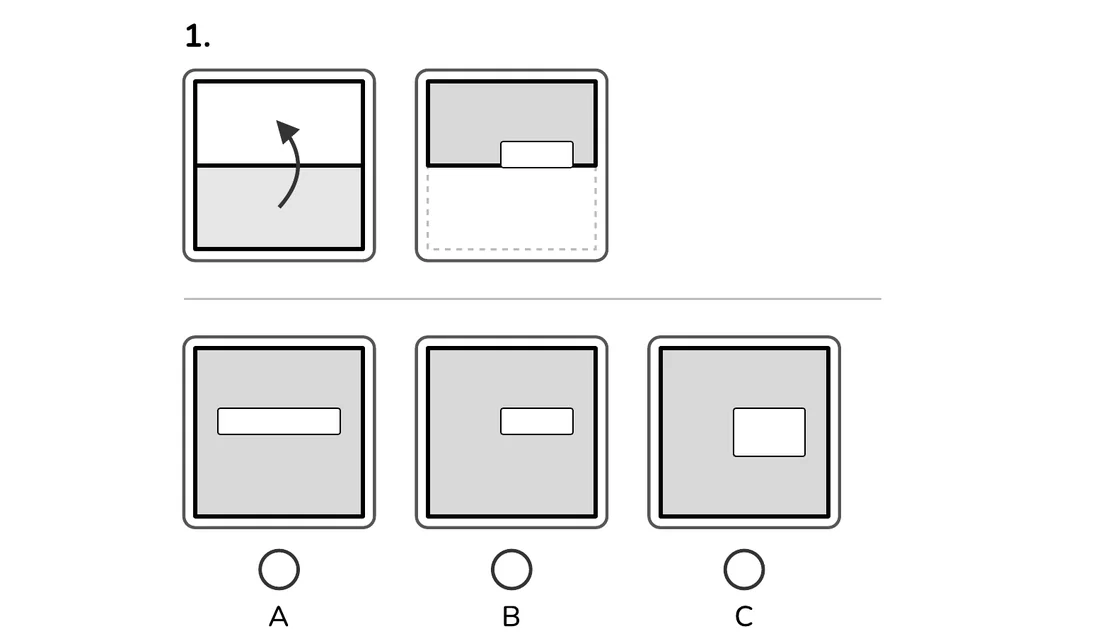
Cuts: the bottom half is folded up, and a small rectangle is cut from the folded edge. The choices show the opened sheet with a wide rectangle, a small rectangle, and a taller rectangle.
The answer is C. The key says: "The bottom half is folded up. The cut goes through every layer, so opened out it makes a taller rectangle."
What does a CogAT Figure Classification question look like?
Figure Classification works like Picture Classification, with shapes instead of pictures. Your child works out how three figures are alike and picks the one answer that goes with them [1]. In our sample the link is the color.
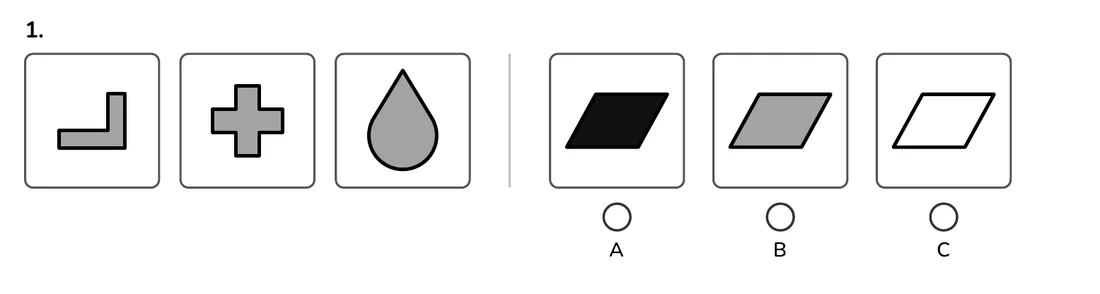
Top row: three grey shapes, an L shape, a cross, and a drop. The choices are three slanted squares: A, black; B, grey; and C, white.
The answer is B. The key says: "The three pictures go together because they are all gray. Only one answer does too."
All nine question types at a glance
| Part | Question type | What your child does | Answer in our sample |
|---|---|---|---|
| Verbal | Picture Analogies | Finds how two pictures go together and copies the link | B |
| Verbal | Sentence Completion | Picks the picture that answers a spoken question | B |
| Verbal | Picture Classification | Picks the picture that belongs with three others | A |
| Quantitative | Number Analogies | Copies a number change from one pair to the next | B |
| Quantitative | Number Puzzles | Makes two trains carry the same number | B |
| Quantitative | Number Series | Finds the next string of beads in a pattern | C |
| Nonverbal | Figure Matrices | Copies a shape change from one pair to the next | A |
| Nonverbal | Paper Folding | Pictures a folded, cut, or punched paper opened out | C and C |
| Nonverbal | Figure Classification | Picks the shape that belongs with three others | B |
On the real test at Level 8 there are 156 questions in all: 54 Verbal, 50 Quantitative, and 52 Nonverbal [3]. These nine show the formats, not the length.
Questions parents ask about CogAT sample questions
Are these real CogAT questions?
No. Every question here was written for our workbook, and none is taken from a real test. They follow the formats Riverside describes for Levels 5/6 to 8 [1], so your child meets each kind of puzzle once before test day.
Do 3rd grade CogAT questions look the same?
No. From Level 9, for 3rd grade, some subtests use written words and number sentences, such as Verbal Analogies and Verbal Classification, so these picture questions do not fit [1]. Our guide what is the CogAT test lists the question types by level.
Where can we find more CogAT practice questions?
Our CogAT Grade 2 practice test workbook has 426 questions like these in 10 short sections and 2 full-length practice tests, each section opening with a worked example. How we check every workbook explains how every answer was proved.
How do we check a whole practice test?
After a full practice test from the workbook, the free answer check marks every answer and lists the question types to practice next, with the book pages. It gives no score, percentile, or IQ.
Do sample questions show what my child would score?
No. A sample question shows the format only. What CogAT scores mean, and why only your school can say which score it wants, is on our page CogAT scores explained.
Sources
- David F. Lohman, CogAT Form 7 Product Guide, Version 4, Riverside Publishing, 2014, pages 7 to 11 and 18. Publisher documentation, copy hosted by the American Association of Christian Schools.
- Riverside, Cognitive Abilities Test Form 7: A Short Guide for Teachers, March 2013.
- David F. Lohman and Joni M. Lakin, CogAT Forms 7 and 8 2017 Norms and Score Conversions Guide, Riverside Assessments, 2019.
- Riverside Insights, CogAT Assessment for K-12, web page, read 15 October 2026.
- Riverside Insights, Overview of CogAT for Parents, parent guide.